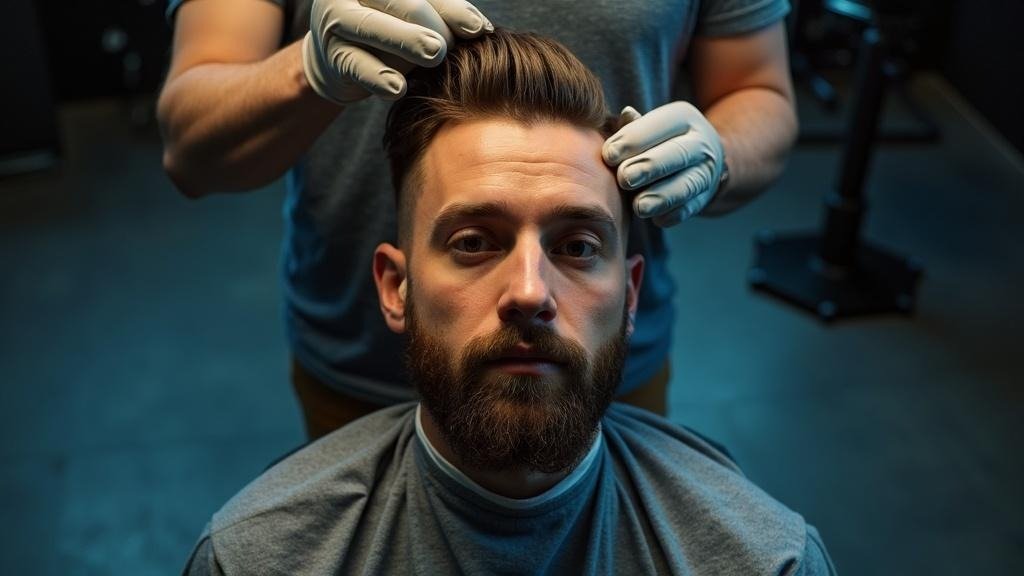
The mistake I see constantly: guys jump straight to buying finasteride or booking a transplant consultation before they even know what Norwood stage they are. Stage 2 and stage 5 are completely different situations. The treatments, the timelines, the costs, none of it lines up the same way. Getting a clear picture of where you actually stand should be step one, not an afterthought.
Here are the tools I trust, sorted by how I actually use them.
Best Starting Point (Free, No Account, No Friction)
1. HairLine AI
Point your webcam at your hairline or upload a photo. The tool maps out facial geometry using MediaPipe, runs the image through Google’s Gemini 3 Pro vision model, and spits out a Norwood classification with an estimated graft count and rough transplant cost range, all without creating an account or entering a credit card. The whole thing takes about ninety seconds. What I like most is the neutrality: it is not trying to sell you a subscription or nudge you toward one brand. It just tells you where you appear to fall on the scale and explains what that stage typically means for treatment options, including whether you are even a transplant candidate yet. An AI read is not a clinical diagnosis, and the tool itself makes that clear. But as a bias-free baseline before any sales conversation? Nothing else I have found is this fast or this free.
See also: Sustainable Tech for a Greener Future
Best for Self-Education on the Norwood Scale
2. The American Hair Loss Association Website
Dense, unsponsored information. The AHLA lays out each Norwood stage with diagrams, explains what progression typically looks like, and discusses which interventions have actual evidence behind them. No product push. Good for cross-referencing whatever an AI tool or clinic tells you.
3. International Society of Hair Restoration Surgery (ISHRS) Patient Resources
The ISHRS site includes detailed visual guides and a surgeon locator. If you are past Norwood 4 and starting to think seriously about surgery, their educational materials will tell you exactly what questions to ask during a consultation.
Best for Getting a Clinical Norwood Read
4. A Board-Certified Dermatologist
I know this sounds obvious. It is still the gold standard. A dermatologist can distinguish androgenetic alopecia from other conditions that mimic pattern baldness, like telogen effluvium or traction alopecia, and an in-person scalp exam catches things no photo ever will. If you have any doubt about what you are dealing with, this is the call.
5. Bosley / BosleyRx Consultation
Bosley comes from a transplant clinic background and offers free in-person or virtual consultations. Their clinicians will stage you using the Norwood scale and discuss both surgical and Rx options. The commercial angle is real, they want clients, but the staging process itself is done by trained staff and tends to be accurate.
Best Telehealth Platforms That Factor in Your Stage
6. Hims
Hims covers the widest treatment range of any telehealth option I have seen. They offer oral finasteride, topical finasteride (which they are the only major platform to carry), oral minoxidil, topical minoxidil, and combination plans. Their intake process asks about your hair loss pattern, so understanding your Norwood stage before you start helps you answer their questions accurately and push for the right plan. Finasteride requires a prescription and comes with real possible side effects, including sexual side effects in a minority of users. Results take months and stop when you stop. Keep that in mind.
7. Keeps
Keeps runs a leaner operation focused specifically on hair loss. Their three-month subscription pricing tends to undercut Hims by a meaningful margin, and shipping runs around five dollars. Like Hims, they offer finasteride and minoxidil. Knowing your Norwood stage lets you have a more grounded conversation with their clinicians about what is and is not realistic for you.
8. Happy Head
Happy Head writes custom topical compound prescriptions, combining finasteride and minoxidil in formulations adjusted to individual cases. If you have had side effects with standard dosing or want something dialed in more precisely, their model is worth looking at. They are a prescription service, not a one-size solution.
Best OTC Options Once You Know Your Stage
9. Generic Minoxidil (Rogaine equivalent)
If you are Norwood 1 through 3 and catching things early, over-the-counter 5% minoxidil is the first thing most dermatologists reach for. Store-brand versions cost a fraction of the Rogaine price and contain the same active ingredient. Twice daily application, every single day, or it stops working. That is the honest reality.
10. Ketoconazole Shampoo (Nizoral or generic)
Not a standalone treatment. Used two or three times a week alongside finasteride or minoxidil, ketoconazole shampoo has some evidence for reducing scalp DHT and improving the environment for existing hair. It costs under fifteen dollars for a large bottle. Minor role, easy addition, low risk.
A Note on Using These Together
The way I approach this: start with an AI-based Norwood read to get oriented, cross-check it against the AHLA diagrams, then take that information into a telehealth intake or a dermatologist visit. You will ask sharper questions. You will be less likely to pay for a transplant consultation you do not need yet, or to under-treat something that has already progressed further than you realized.
No tool on this list replaces a clinician’s judgment. AI staging, OTC products, and telehealth platforms are all starting points or supplements. A dermatologist who can see your actual scalp remains the most reliable voice in the room.
Common Questions
How accurate is HairLine AI’s Norwood staging compared to what a dermatologist would say?
HairLine AI uses Google’s Gemini 3 Pro vision model and MediaPipe facial geometry mapping, which makes it more systematic than a self-assessment in a mirror. That said, photos miss scalp texture, density under lighting, and diffuse thinning that a clinician catches by touch. Treat the AI output as a solid orientation, not a final answer.
Does knowing your Norwood stage actually change what Hims or Keeps prescribes you?
Yes, in a practical way. Both platforms ask about your hair loss pattern during intake. If you walk in knowing you are a Norwood 3 vertex versus a Norwood 2, you can describe your situation more precisely, which helps the clinician decide whether a combination plan makes sense or whether standard minoxidil alone is the starting point.
At what Norwood stage does a transplant consultation with Bosley or ISHRS surgeons become worth your time?
Most transplant surgeons consider Norwood 3 the lower boundary worth discussing, though many prefer to wait until stage 4 or beyond so the donor area and future loss pattern are more predictable. Going earlier is not wasted time if you want education, but a surgeon is unlikely to recommend surgery at stage 2.
Can Happy Head’s custom compounds replace the standard finasteride and minoxidil you would get from Keeps or Hims?
They contain the same active ingredients. The difference is concentration and formulation, Happy Head adjusts the ratio and delivery base per prescription. For most Norwood 2 to 4 cases, standard off-the-shelf dosing works fine. Custom compounding is more relevant if you have had scalp irritation, systemic side effects at standard doses, or want a single daily application instead of two separate products.
Is the AHLA’s Norwood stage information reliable enough to use before a clinical appointment?
The American Hair Loss Association’s stage guides are well-regarded reference material and carry no commercial interest in steering you toward a product. They are accurate for general education. What they cannot do is tell you whether your hair loss is androgenetic or something else entirely, which is exactly why a dermatologist visit still matters even after you have done your reading.
Sources
- American Hair Loss Association, alopecia stage guides and treatment overviews
- International Society of Hair Restoration Surgery, patient education resources
- Hims product and ingredient disclosures (publicly listed on their website)
- Keeps pricing and shipping terms (publicly listed on their website)
- Happy Head compound formulation descriptions (publicly listed on their website)
- Bosley consultation process descriptions (publicly listed on their website)
- U.S. National Library of Medicine, MedlinePlus entries on finasteride and minoxidil


 By
By